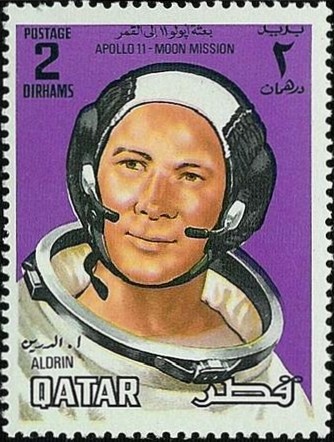
Edwin E. Buzz Aldrin Jr. (1930) - 2 dirham
Edwin E. "Buzz" Aldrin Jr. (1930) is an American astronaut, engineer, and fighter pilot who earned his place in history alongside Neil Armstrong during the historic 1969 Apollo 11 moon mission. Born in Montclair, New Jersey, Aldrin graduated third in his class from the United States Military Academy at West Point in 1951 and commissioned into the U.S. Air Force. As a jet fighter pilot during the Korean War, he flew 66 combat missions in F-86 Sabres, shooting down two enemy MiG-15 aircraft. Following his combat service, he pursued higher education at the Massachusetts Institute of Technology (MIT), earning a Doctorate of Science (Sc.D.) in astronautics. His groundbreaking doctoral thesis on manned orbital rendezvous techniques earned him the nickname "Dr. Rendezvous" and pioneered the precise calculations that would later make NASA's space docking maneuvers possible, leading to his selection as a NASA astronaut in 1963.
During the historic July 20, 1969 lunar landing, Aldrin served as the Lunar Module Pilot, meticulously managing the complex system telemetry of the Eagle as it touched down on the Sea of Tranquility. Stepping onto the lunar surface just nineteen minutes after Neil Armstrong, Aldrin famously described the alien terrain as a scene of "magnificent desolation," capturing the stark, silent beauty of the lunar environment. He also made history during the mission by performing the first religious ceremony on the Moon, privately taking Communion on the lunar module's tray table before stepping outside. Following his retirement from NASA in 1971 and the military in 1972, Aldrin became a passionate, lifelong advocate for the continued human exploration of space, famously championing the "Cycling Pathways to Mars" master plan for regular, reusable transit to the Red Planet.
During the historic July 20, 1969 lunar landing, Aldrin served as the Lunar Module Pilot, meticulously managing the complex system telemetry of the Eagle as it touched down on the Sea of Tranquility. Stepping onto the lunar surface just nineteen minutes after Neil Armstrong, Aldrin famously described the alien terrain as a scene of "magnificent desolation," capturing the stark, silent beauty of the lunar environment. He also made history during the mission by performing the first religious ceremony on the Moon, privately taking Communion on the lunar module's tray table before stepping outside. Following his retirement from NASA in 1971 and the military in 1972, Aldrin became a passionate, lifelong advocate for the continued human exploration of space, famously championing the "Cycling Pathways to Mars" master plan for regular, reusable transit to the Red Planet.