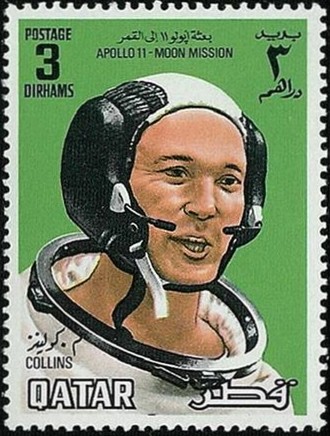
Michael Collins (1930–2021) - 3 dirham
Michael Collins (1930–2021) was an American astronaut, test pilot, and military officer who played a vital, yet uniquely solitary, role as the third crew member on the historic 1969 Apollo 11 moon mission. Born in Rome, Italy, to a prominent U.S. Army family, Collins graduated from the United States Military Academy at West Point in 1952 and chose a career in the U.S. Air Force. He served as a fighter pilot before being accepted into the prestigious USAF Experimental Flight Test Pilot School at Edwards Air Force Base, logging thousands of hours flying advanced jet aircraft. His elite piloting skills and engineering acumen earned him selection into NASA’s third astronaut group in 1963. He first flew in space in July 1966 as the pilot of Gemini 10, where he performed two successful spacewalks and helped execute a critical orbital rendezvous, setting the stage for his assignment to the first lunar landing crew.
While Neil Armstrong and Buzz Aldrin descended to the lunar surface on July 20, 1969, Collins remained in lunar orbit aboard the Command Module Columbia. For over 21 hours, he cycled around the Moon completely alone, managing the intricate spacecraft systems and serving as the essential lifeline that would bring his crewmates home. Every time his orbit took him behind the far side of the Moon, he was cut off from all radio communication with Earth, earning him the title of "the loneliest man in history"—a title he humbly downplayed, noting he felt a profound sense of awareness and privilege rather than isolation. After safely executing the critical rendezvous that reunited the crew for their triumphant return to Earth, Collins retired from NASA in 1970. He went on to serve as the Assistant Secretary of State for Public Affairs and became the founding director of the Smithsonian’s National Air and Space Museum, preserving his deep love for aviation history until his passing in 2021.
While Neil Armstrong and Buzz Aldrin descended to the lunar surface on July 20, 1969, Collins remained in lunar orbit aboard the Command Module Columbia. For over 21 hours, he cycled around the Moon completely alone, managing the intricate spacecraft systems and serving as the essential lifeline that would bring his crewmates home. Every time his orbit took him behind the far side of the Moon, he was cut off from all radio communication with Earth, earning him the title of "the loneliest man in history"—a title he humbly downplayed, noting he felt a profound sense of awareness and privilege rather than isolation. After safely executing the critical rendezvous that reunited the crew for their triumphant return to Earth, Collins retired from NASA in 1970. He went on to serve as the Assistant Secretary of State for Public Affairs and became the founding director of the Smithsonian’s National Air and Space Museum, preserving his deep love for aviation history until his passing in 2021.