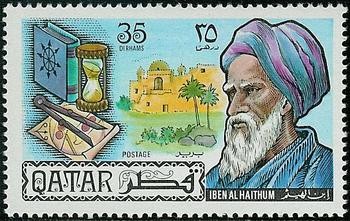
Al-Hasan Ibn al-Haytham (c. 965–1040 CE)
Al-Hasan Ibn al-Haytham (c. 965–1040 CE), Latinized as Alhazen, was a pioneering polymath, mathematician, and physicist of the Islamic Golden Age whose revolutionary work earned him the title of the "father of modern optics." Born in Basra and spending the most productive years of his career in Cairo under the Fatimid Caliphate, he fundamentally transformed how humanity understands vision. In his monumental seven-volume masterpiece, Kitab al-Manazir (The Book of Optics), he systematically dismantled the ancient Greek theories of emission and reception, proving through rigorous experimentation that vision occurs when light reflects off an object and enters the eye, rather than light originating from within the eye itself.
Beyond his monumental discoveries in physics, geometry, and psychology, Ibn al-Haytham is arguably most significant for developing the core foundation of modern science: the scientific method. Centuries before European thinkers of the Renaissance, he insisted that hypotheses must be tested through precise, repeatable, and quantifiable physical experimentation rather than relying solely on abstract philosophical deduction. Using early camera obscura models, pinhole lenses, and mathematical analyses of refraction and reflection, his uncompromising commitment to empirical testing bridged physics and mathematics. His Latinized translations deeply influenced Western thinkers like Roger Bacon, Johannes Kepler, and René Descartes, cementing his legacy as a foundational figure in the global scientific revolution.
Beyond his monumental discoveries in physics, geometry, and psychology, Ibn al-Haytham is arguably most significant for developing the core foundation of modern science: the scientific method. Centuries before European thinkers of the Renaissance, he insisted that hypotheses must be tested through precise, repeatable, and quantifiable physical experimentation rather than relying solely on abstract philosophical deduction. Using early camera obscura models, pinhole lenses, and mathematical analyses of refraction and reflection, his uncompromising commitment to empirical testing bridged physics and mathematics. His Latinized translations deeply influenced Western thinkers like Roger Bacon, Johannes Kepler, and René Descartes, cementing his legacy as a foundational figure in the global scientific revolution.